
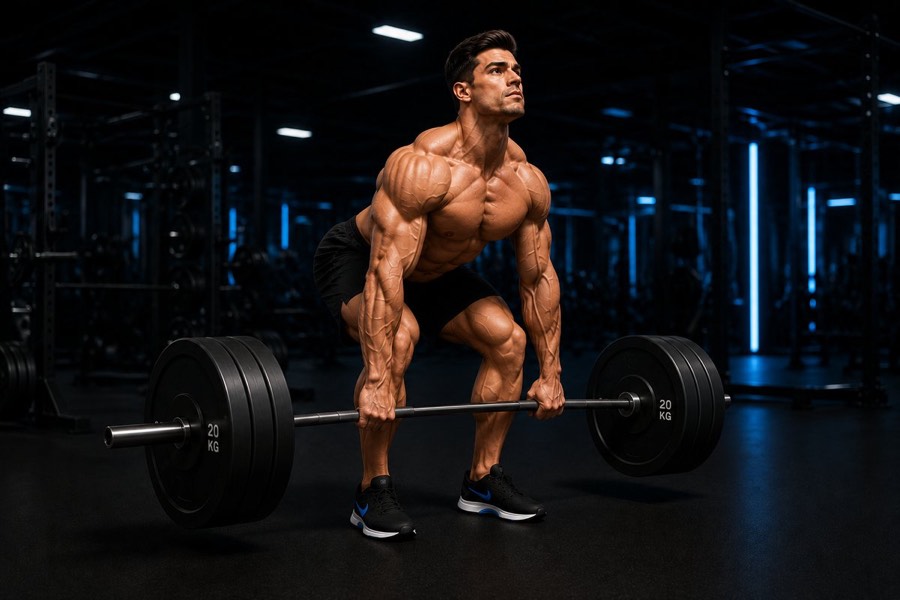
Free Weights Only Workout Plan
You don't need a single machine to build muscle and get strong. A barbell, a pair of adjustable dumbbells, and a bench cover every major movement pattern your body needs. Here's a complete 4-day free weights only split, built for a home gym or a busy commercial gym where the machines are always taken.
Machines get sold as the beginner-friendly option, and cables get sold as essential for isolation work. Neither claim holds up. Free weights train the target muscle plus the stabilizers around it, let you adjust load in small increments, and travel with you if you ever train somewhere without a full machine lineup. The only thing you actually need is a plan that uses them properly.
What counts as free weights
For this plan, free weights means a barbell and plates, a set of dumbbells (ideally adjustable, or a wide range of fixed pairs), and a flat or adjustable bench. No cable stack, no leg press, no chest press machine, no lat pulldown. If you also have a pull-up bar, even better, but it isn't required since the plan below substitutes dumbbell rows and covers the same muscles.
Who it's for
- Home gym owners who have a barbell, a bench, and dumbbells but no machines.
- Anyone training at a busy commercial gym who wants a plan that never depends on a specific machine being free.
- Lifters who travel often and need a structure that works in almost any gym they walk into.
The three principles behind the plan
Principle 1: cover every movement pattern
A complete plan hits a squat, a hinge, a horizontal push, a horizontal pull, a vertical push, and a vertical pull every week. Free weights cover all six without a single machine: back squat or goblet squat, Romanian deadlift, bench press or dumbbell press, dumbbell row, overhead press, and pull-up or dumbbell row variation. Want heavier, lower-rep work on those lifts too? That's powerbuilding, and it runs fine with free weights only.
Principle 2: let dumbbells do the isolation work
Cable machines exist mainly for constant tension on isolation exercises. Dumbbells get you almost all of that benefit: lateral raises, curls, triceps extensions, and rear delt flyes all load the muscle through a full range without a cable in sight. The tension curve is slightly different, not worse.
Principle 3: progress load or reps every session
With machines, small plates make tiny jumps easy. With free weights, especially dumbbells, jumps can be bigger (often 2 to 5 kg per side). Use reps to bridge the gap: work in a rep range like 8 to 12, add a rep each week, and only increase the weight once you hit the top of the range on every set.
A free 4-day upper/lower split
Train Monday, Tuesday, Thursday, Friday, or any pattern with a rest day after every two sessions. Every exercise here uses only a barbell, dumbbells, and a bench.
| Day | Main lifts | Accessories |
|---|---|---|
| 1 · Upper | Barbell bench press, 4x6 | Dumbbell row, seated dumbbell shoulder press, dumbbell lateral raise, dumbbell curl, lying triceps extension |
| 2 · Lower | Barbell back squat, 4x6 | Romanian deadlift, dumbbell walking lunge, dumbbell Bulgarian split squat, standing calf raise |
| 3 · Upper | Dumbbell bench press, 4x10 | Single-arm dumbbell row, standing barbell overhead press, dumbbell rear delt fly, hammer curl, overhead dumbbell triceps extension |
| 4 · Lower | Barbell deadlift, 4x5 | Goblet squat, dumbbell hip thrust, dumbbell step-up, seated calf raise |
Rest 2 to 3 minutes after the main lift, 60 to 90 seconds between accessories. Total session time lands around 50 to 65 minutes.
Substitutions if you're missing something
- No barbell: replace bench press with dumbbell bench press, back squat with goblet or dumbbell front squat, and deadlift with dumbbell Romanian deadlift.
- No bench: use the floor for dumbbell presses (floor press), and swap seated shoulder press for a standing version.
- No pull-up bar: the plan above already relies on rows instead, so nothing changes.
How to progress week to week
- Main lifts: hit every prescribed rep on every set? Add the smallest available plate next session. Miss reps two sessions running? Drop the weight 10% and build back up.
- Accessories: add a rep to each set until you reach the top of the range across the board, then move up to the next dumbbell size and reset the reps.
- Every 4 to 8 weeks: take a deload week at roughly 60% of your usual weights and half the sets. Recovery drives the next block of progress.
Common mistakes
- Stopping the jumps too early. Dumbbells often jump by 2.5 to 5 kg per side. If that feels too big, add reps for a few extra weeks before moving up instead of stalling.
- Skipping the hinge pattern. Squats get all the attention, but a Romanian deadlift or a barbell deadlift is what actually builds the hamstrings and lower back. Don't leave it out.
- No plan for isolation work. Doing curls and lateral raises for random reps until it feels like enough isn't progressive overload. Track sets, reps, and weight for every exercise, not just the main lifts.
Build this plan automatically in NXTSTEP Fitness
NXTSTEP Fitness lets you set your equipment to mostly free weights when building a plan, and it filters out machine and cable exercises completely, swapping in barbell and dumbbell alternatives for every slot. It logs your sets, reps, weight, and rest automatically, charts your progress over time, and turns consistency into XP and rank so you keep showing up.
FAQ
Can you build muscle with free weights only?
Yes. Muscle growth depends on progressive overload and training close to failure, not on the equipment you use. A barbell and a pair of dumbbells can train every major muscle group as hard as any machine can.
Do I need a barbell, or is dumbbells only enough?
Dumbbells alone are enough to build a complete physique, especially with adjustable dumbbells that go heavy. A barbell makes it easier to overload the biggest lifts like the squat and deadlift, so it helps but isn't required.
Is a free weights only workout enough without machines?
Yes, for the vast majority of lifters. Machines isolate a muscle with less technique demand, but free weights train the same muscles plus stabilizers, and let you progress load in smaller increments across almost every exercise.
How many days a week should I train with just free weights?
Three to four days works well for most people. A 4-day upper/lower split lets you hit each muscle group twice a week with free weights alone, while leaving enough recovery time between sessions.